A large ramen multipack looks convenient until you notice the date and realize you only eat noodles occasionally. The useful question is not simply whether instant ramen “expires.” It is whether the exact food you bought is still within its labeled quality period, has been stored as directed, and belongs in a pantry at all.
For US shoppers buying Korean ramen, start with three choices: keep unopened shelf-stable packs in a shaded place away from heat; buy a quantity you can realistically use; and treat cooked noodles as perishable leftovers, not as the dry product they started as. Refrigerated or frozen noodles are outside the dry-pantry category and need their own label instructions.
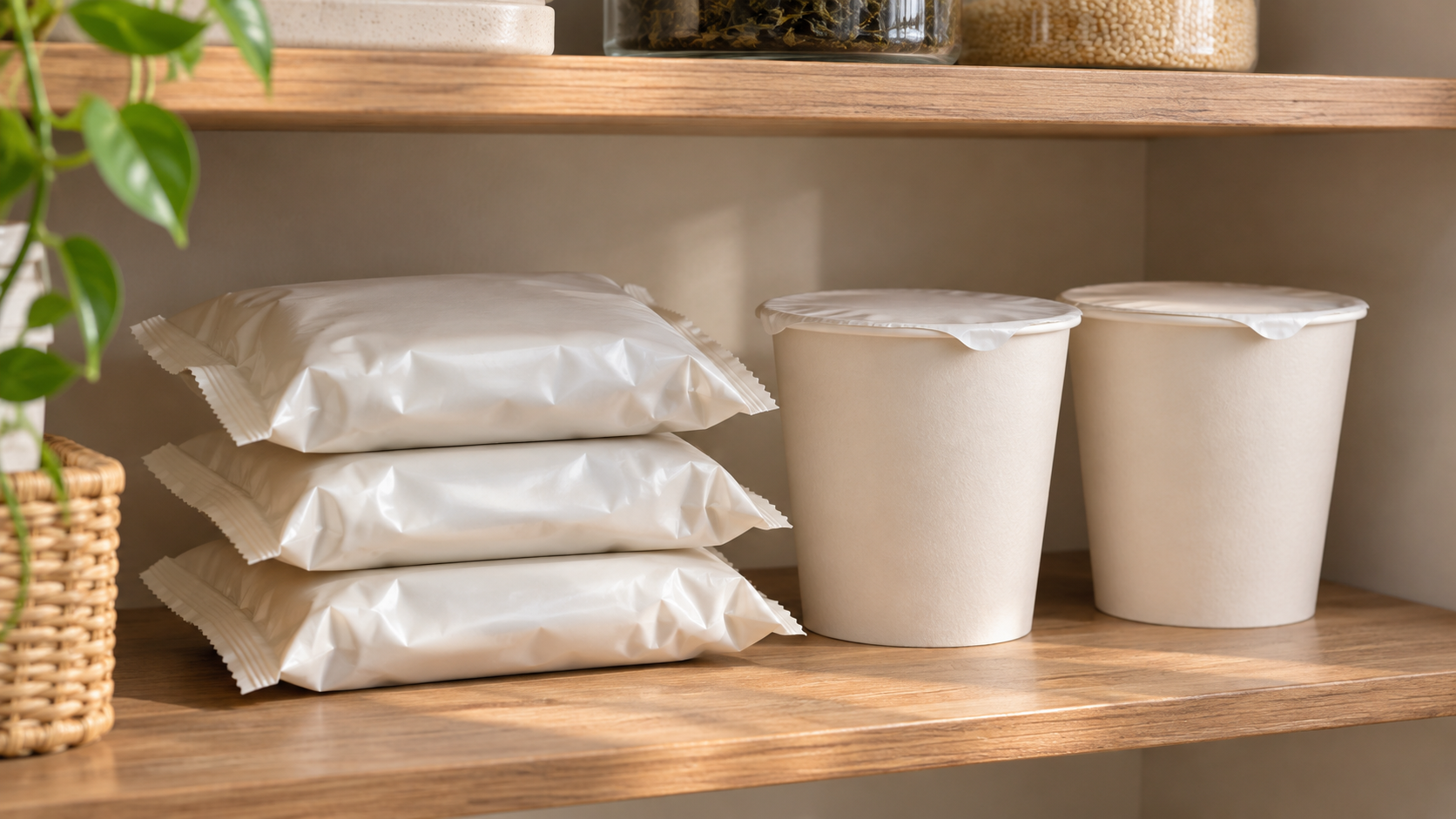
Choose the storage place before buying the multipack
A cupboard beside the stove may be convenient for cooking, but it is not automatically the best place for the unopened packets. In its official ramen-storage guidance, Nongshim recommends avoiding direct sunlight and keeping room-temperature products away from cooking appliances and heaters for long periods. It explains that storage conditions affect oxidation in fried noodles and that heat can reduce quality.
That manufacturer article is Korean guidance about storage principles, not a verified shelf-life statement for every US Shin Ramyun, Buldak or other imported product. Use it to choose a better location, then follow the temperature and storage directions on the exact package you receive. Do not use a Korean-market article to replace a US product label.
| Storage option | What to check | Practical choice |
|---|---|---|
| Shaded pantry shelf | Package permits room-temperature storage; shelf stays away from heat sources. | A suitable starting point for unopened shelf-stable ramen when label conditions are met. |
| Beside stove, oven or heater | Repeated or prolonged heat exposure. | Choose another shelf; Nongshim specifically cautions against nearby cooking and heating appliances. |
| Refrigerator or freezer | Product specifically requires refrigeration or freezing. | Follow its own instructions; do not apply a dry-noodle rule to chilled or frozen noodles. |
Keep food separate from cleaning products and household chemicals. That is part of the FDA’s general storage guidance, not a ramen-specific shelf-life extension. A tidy pantry still needs label checks; moving a questionable packet to a better cupboard does not establish that it is safe.
Read the words beside the date, not only the numbers
The FDA explains in its food-waste and food-dating guide that “Best if Used By” indicates the period of best flavor and quality. It also says there are no uniform or universally accepted descriptions for open dating on US food labels. That is why a date should be read together with its wording and the manufacturer’s directions.
This is not permission to eat any old packet after a date. General quality-date guidance does not calculate a safe additional number of months for a particular noodle block, sauce sachet or cup. The sources reviewed here do not establish a universal post-date allowance for Korean instant ramen, so this guide does not provide one.
| Marking or information | What it can tell you | What it cannot establish alone |
|---|---|---|
| “Best if Used By” | A quality date, as described by FDA guidance. | That the packet is safe regardless of storage history or condition. |
| A printed code without clear wording | A code to identify when contacting the manufacturer. | Whether it is a production date, quality date or lot code without further explanation. |
| Storage directions | The conditions the manufacturer tells you to follow. | A guaranteed extra shelf life after opening or after the printed date. |
If a date looks ambiguous, record the full code and contact the company identified on the package rather than guessing the month/day order or borrowing another brand’s decoding rule. Keep the product name, pack size and market information with that question. A multipack listing or a seller’s photograph may not describe the batch that actually arrives.
For ingredients and allergen wording, our Korean food-label guide for US shoppers covers a different check: whether a product suits your dietary needs. A storage date is not an allergen statement, and an allergen statement is not a storage instruction. Both need attention.
A small buying calculation that prevents an oversized pantry
Before choosing a bulk deal, compare the number of packs with your own planned use. This is a shopping calculation, not a laboratory shelf-life test. It only answers how long the purchase would take to finish at a stated rate. It cannot add time to the label, repair poor storage, or verify safety.
Use packs divided by planned packs per week. For example, a person who expects to use two packs each week would need ten weeks for twenty packs. Someone planning one pack every two weeks would need forty weeks for the same purchase. These are hypothetical quantities and habits, not observations of a retailer’s stock or recommendations about how often to eat ramen.
| Hypothetical purchase | Planned use | Time to finish |
|---|---|---|
| 5 packs | 1 pack each week | 5 ÷ 1 = 5 weeks |
| 20 packs | 2 packs each week | 20 ÷ 2 = 10 weeks |
| 20 packs | 1 pack every 2 weeks, or 0.5 per week | 20 ÷ 0.5 = 40 weeks |
Compare that result with the date on the stock you can actually buy and the storage space available at home. If you cannot verify the date before ordering, ask the seller rather than assuming a full shelf-life period starts on delivery day. If the purchase would take longer to finish than you are comfortable planning for, a smaller quantity is the simpler choice.
Our Korean ramen buying guide can help with retailer questions, while the Korean pantry guide puts noodles alongside other staples. Neither replaces the package you receive. For a first order, use the beginner noodle guide to compare options before committing to a large quantity of one style. If two similarly named pink pouches are on your shopping list, our US Carbonara versus Cream Carbonara comparison helps distinguish the products before you choose a multipack. It is a buying comparison, not a shelf-life test.
The storage rules change after cooking
Once noodles have been prepared, the unopened packet’s pantry status is no longer the relevant rule. FDA guidance says foods requiring refrigeration, including leftovers, should not remain at room temperature for more than two hours, or more than one hour when the air temperature is above 90°F. It recommends keeping the refrigerator at or below 40°F (4°C).
Apply that perishable-food handling guidance to prepared ramen, particularly meals with added meat, eggs or other perishable ingredients. Refrigerate promptly rather than treating a covered bowl on the counter as stored food. The two-hour threshold is not a recommended waiting period, and a refrigerator does not undo earlier unsafe holding.
Do not use this article to assign an unverified refrigerator life to every ramen recipe. Ingredients, handling and product instructions differ. The FDA sources cited here support prompt refrigeration and temperature control; they do not provide a tested refrigerated lifetime for every bowl you might make.
Cooking and storage are separate decisions. Read the actual preparation instructions before starting: a soup noodle and a drained sauce noodle can require different handling. See bag and cup cooking instructions and our Shin Ramyun versus Buldak comparison for product-style context. Do not assume that a dry packet, a prepared bowl and a separately bottled sauce share one storage rule.
Condition matters, but a smell check is not a safety test
The FDA advises discarding food that looks or smells suspicious and warns that food can also cause illness without looking, smelling or tasting spoiled. Those two points belong together. Obvious spoilage is a reason to stop; an absence of obvious spoilage is not proof that questionable food is safe. Do not taste food to decide whether uncertain storage was acceptable.
For an unreadable code, damaged packaging, uncertain storage history or product-specific concern, pause and contact the manufacturer or seller. Do not turn a generic internet “months after expiration” range into a decision about your exact packet. If you are unsure or the food looks questionable, FDA guidance is to throw it out.
Keep dietary checks separate too. For example, our selected US Buldak milk-label comparison concerns specific products and label declarations; it does not tell you how long any opened sachet can be stored. Choosing an appropriate product does not remove the need to follow its date, storage and preparation instructions.
What to do with the next packet
Find its storage directions and the wording beside its date. Choose a shelf away from sunlight, cooking appliances and heaters if it is a room-temperature product. Then divide the quantity you plan to buy by your realistic weekly use. That gives you a useful buying decision without inventing a universal shelf life or relying on a personal taste test.
Research method and limits: On November 22, 2026, KRODUCT compared two FDA consumer guides with Nongshim’s Korean storage explainer and built the storage-choice, date-reading and buying-calculation tables above. The FDA pages show content dates of March 5, 2024 and January 18, 2023; Nongshim’s article is dated March 26, 2019. These are document-based comparisons, not package photography, product testing or verification of a particular US batch. Manufacturer guidance is identified by market rather than presented as a US label. The illustrations are not evidence of storage testing.
Official sources
- FDA: How to Cut Food Waste and Maintain Food Safety (date-label meaning and general food-handling guidance).
- FDA: Are You Storing Food Safely? (refrigeration, temperature, spoilage and storage cautions).
- Nongshim: How should ramen be stored to keep it fresh? (Korean-language manufacturer storage guidance).
Last checked: November 22, 2026.
케이프로덕트 조사팀 · 디노벤처스 · Source-based Korean product research. Questions or corrections: contact KRODUCT.