Buldak Carbonara vs Cream Carbonara, quick answer: these are two separate US pouches. Buldak Ramen Carbonara is 4.58 OZ (130g); Buldak Ramen Cream Carbonara is 4.93 OZ (140g). Both are listed with the same official “Spicy Level 2” marking on their individual US product pages, and they also have listed sauce/powder ingredient differences covered below.
The two pouches share a similar pink look and a “creamy spicy” theme, so a shopper glancing at a thumbnail photo can easily grab the wrong one.
Three Checks Before You Buy
- Exact name check: Read the full printed name, not just the pink color. “Buldak Ramen Carbonara” and “Buldak Ramen Cream Carbonara” are two different listings.
- Weight/package check: Confirm the printed net weight: 4.58 OZ (130g) for Carbonara or 4.93 OZ (140g) for Cream Carbonara. For multipacks, check every unit’s photo against the weight in the title.
- Allergen check: Before cooking, read the full ingredient list together with the separate “CONTAINS” line on your own received pouch, not the CONTAINS line alone. Both products list wheat, soy, and milk in both places as of the official pages checked for this guide, but no warning on one print run is not a guarantee for every run, and labels can be revised later.
Comparison Table
| Detail | Buldak Ramen Carbonara | Buldak Ramen Cream Carbonara |
|---|---|---|
| Official US pouch name | Buldak Ramen Carbonara | Buldak Ramen Cream Carbonara |
| Net weight | 4.58 OZ (130g) | 4.93 OZ (140g) |
| Spicy level (as listed on official page) | Level 2 | Level 2 |
| Boil water / time | 2½ cups (20 OZ), 5 minutes | 2½ cups (20 OZ), 5 minutes |
| Water retained for mixing | ½ cup (4 OZ) | ½ cup (4 OZ) |
| Add-in step wording | Sauce and cheese powder | Sauce and powder |
| Sauce: ingredient listed in one but not the other | Lists no separate “Cheese Sauce” sub-ingredient; lists Soy Sauce (water, defatted soybean, salt, wheat) | Lists an added “Cheese Sauce” sub-ingredient (mozzarella cheese, whey, dextrin, skim milk powder) and Monosodium Glutamate |
| Powder: cheese ingredient naming | “Mozzarella Cheese” | “Mozzarella Cheese Powder,” plus an added “Mixed Cheese Powder” (cheddar, gouda, camembert) |
| Powder: ingredients listed only in Carbonara | Food Starch-Modified, Garlic, Black Pepper | – |
| Powder: shared in both (not exclusive) | Parsley, Soybean Oil | Parsley, Soybean Oil |
| Declared allergens (as listed) | Wheat, soy, milk | Wheat, soy, milk |
Same Pink Family, Two Different Pouches
Both belong to Samyang’s “Carbo Buldak” line. Carbonara’s official page lists it as “A Flavor Enjoyable for Consumers Who Find the Spiciness of Buldak Original Too Intense.” Cream Carbonara’s official page lists it as “Buldak Made Creamier and Smoother with the Addition of Cream to Carbo Buldak!” Both are the manufacturer’s own marketing wording, not an independently tested comparison; beyond that wording, the two pages share a similar pink color scheme, which is enough overlap for a shopper comparing thumbnails to pick the wrong pouch.
Weight Difference: 130g vs 140g
The clearest difference is net weight: 130g for Carbonara versus 140g for Cream Carbonara, a 10 gram (about 7.7%) gap in total pouch weight. The official pages do not publish how that extra 10 grams is split between noodles, sauce, and powder, so this guide does not estimate or assume that split.
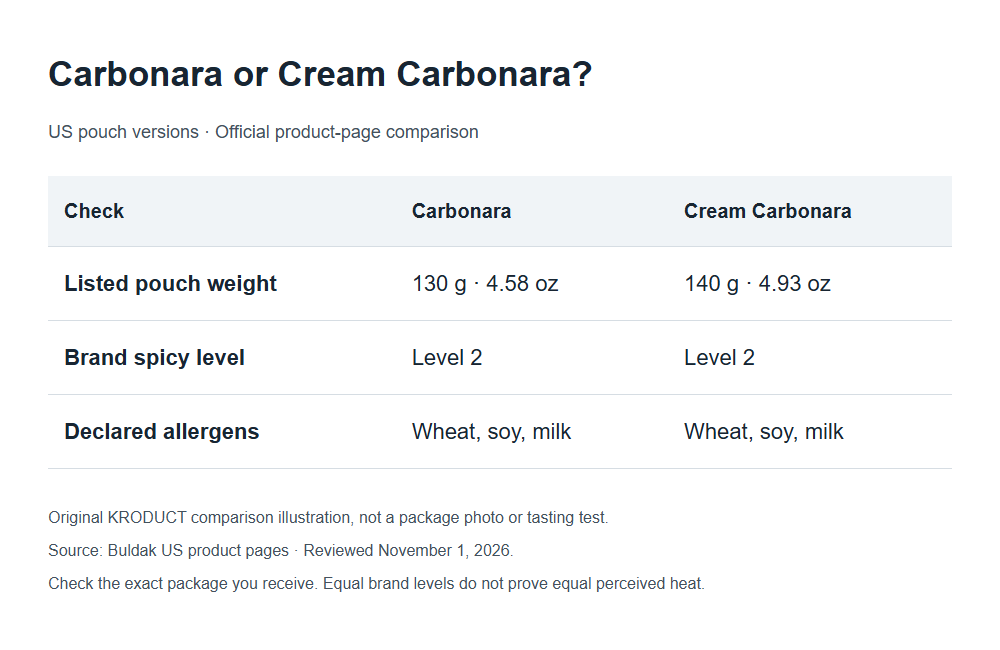
Because both pouches share the same “Pouch Noodles US Version” format and boiling method, you cannot tell them apart by silhouette. The printed weight and full product name are the only reliable identifiers.
Spice Level: Both Listed as Level 2
Both official product pages display the same “Spicy Level 2” text and icon. That is the only spice data these two pages provide; the sources checked for this guide do not establish how Samyang’s spiciness marking works across its wider product catalog, so this guide makes no claim about a broader 1-through-5 scale. Matching brand-listed levels for these two products also does not prove the two pouches taste equally hot to any given person; ingredient differences exist (see below) and perceived heat is not something this guide has tested. For a broader look at Buldak flavors generally, see our Buldak flavor overview.
Cooking Instructions: Nearly Identical Steps
Both pouches use the same steps: boil 2½ cups (20 OZ) of water, add noodles, cook 5 minutes; drain most water while keeping ½ cup (4 OZ); add the sauce packet. The only wording difference is Carbonara’s page says to add “sauce and cheese powder,” while Cream Carbonara’s page says “sauce and powder” – a naming difference, not an extra step. See our how to cook Korean ramen guide for the general boil-drain-mix pattern.
Ingredient Differences That Actually Matter
The noodle block lists the same ingredient names for both: wheat flour, modified food starch, palm oil, salt, glycerin, soybean oil, guar gum, water, potassium carbonate, riboflavin. Matching names does not mean matching ratios, process, or texture, since the official pages list ingredients only, not quantities.
In the sauce, Carbonara lists Soy Sauce (water, defatted soybean, salt, wheat), chili pepper, and chili pepper oleoresin. Cream Carbonara’s sauce additionally lists a “Cheese Sauce” sub-ingredient (mozzarella cheese, whey, dextrin, enzymes, annatto extract, water, yeast extract, skim milk powder) and Monosodium Glutamate, neither listed in Carbonara’s sauce. The sub-ingredient lists above are a partial selection of the differences, not a full verbatim transcription of every nested item on either label; always check your own pouch for the complete printed list.
In the powder, both list milk, sugar, salt, butter, parsley, and soybean oil. The cheese naming differs: Carbonara lists plain “Mozzarella Cheese,” while Cream Carbonara lists “Mozzarella Cheese Powder” and additionally lists a “Mixed Cheese Powder” (cheddar, gouda, camembert) not present in Carbonara’s powder. Carbonara’s powder, in turn, lists Food Starch-Modified, Garlic, and Black Pepper, which do not appear in Cream Carbonara’s powder list. Both pages list the same allergen statement: wheat, soy, milk. An overlapping ingredient name like “mozzarella cheese” in both does not mean the two sauces or powders are made the same way or taste the same.
A Simple Unit-Price Example (Hypothetical)
No live prices are quoted here. Use this formula at checkout instead: price divided by ounces equals price per ounce. If a 4.58 OZ Carbonara pouch were a hypothetical $1.50, that is about $0.33/oz. If a 4.93 OZ Cream Carbonara pouch were the same hypothetical $1.50, that is about $0.30/oz, simply because the pouch is heavier for the same price. Use the real price you see on the day you shop; the numbers above are illustrative only, not pulled from any live listing or real stock.
What To Do With Your Own Pouch
When your order arrives, match the printed name and weight against the details above. If you have a dietary restriction tied to wheat, soy, or milk, read the full ingredient list and the “CONTAINS” line on your own package together, not the CONTAINS line alone; labels can be revised after this guide was checked, and no warning on one print run does not guarantee every run is the same. See our Korean food labels and allergens guide for how these labels are generally structured.
Conclusion
Buldak Ramen Carbonara and Buldak Ramen Cream Carbonara are listed on the official US product pages as two separate pouches: a 10 gram weight gap, matching Level 2 spice listings, nearly identical boiling steps, and listed ingredient differences in the sauce and powder – most notably Cream Carbonara’s added “Cheese Sauce” component and its extra cheddar-gouda-camembert powder blend. Matching spice listings do not guarantee matching perceived heat, and neither pouch has been tasted or tested for this guide. Check the exact name, weight, and full ingredient/allergen text on your own package rather than judging by color.
Sources
- Buldak Ramen Carbonara – official US product page (buldak.com, checked November 1, 2026)
- Buldak Ramen Cream Carbonara – official US product page (buldak.com, checked November 1, 2026)
Last reviewed: November 1, 2026. Editorial note: this is a desk comparison of the two official US pouch product pages above. Neither product was purchased, tasted, cooked, or physically received for this guide, and no package photos were taken. The comparison image is an original illustration limited to weight, listed spice level, and declared-allergen facts stated in this article; it is not a photo of real packaging and not a screenshot of the source site.