Quick answer: On their official US bag labels, Shin Original is 520 calories and 1,620mg sodium per full 120g bag, while Shin Black is 560 calories and 1,880mg sodium per full 130g bag. Both list beef bone extract and “Contains wheat and soy.”
- Lower calories/sodium for the full bag: Original.
- Curious about Nongshim’s description of Black’s beef bone broth: check Black’s ingredient list placement below.
- Avoiding wheat, soy, or eating vegetarian: neither of these two bags works for you.
This article lines up the official US Nongshim label facts for the bag versions of Shin Original and Shin Black, so you can pick by the numbers on the package rather than a flavor opinion. It does not cover cooking water or timing; for that, see our how to cook Korean ramen guide instead.
Shin Original and Shin Black, Side by Side
Both bags are labeled “2 servings per container,” but a serving is not the same weight on each bag: one serving is half a bag, which is 60g for Original and 65g for Black. Because the serving weights differ, the table below also lists the official full-bag totals, which is the number that matters if you eat the whole bag in one sitting.
| Label fact (bag version) | Shin Original | Shin Black |
|---|---|---|
| Serving size (1/2 bag) | 60g | 65g |
| Servings per container | 2 | 2 |
| Total bag weight | 120g | 130g |
| Calories per serving | 260 | 280 |
| Calories per full bag | 520 | 560 |
| Sodium per serving | 810mg | 940mg |
| Sodium per full bag | 1,620mg | 1,880mg |
| Total carbohydrate per full bag | 83g | 89g |
| Protein per full bag | 11g | 15g |
| Contains | Wheat and soy | Wheat and soy |
Source: Nongshim USA official product pages for Shin Ramyun Original and Shin Ramyun Black, read November 4, 2026. Full-bag values are the official per-bag column printed on each label, not a calculation.
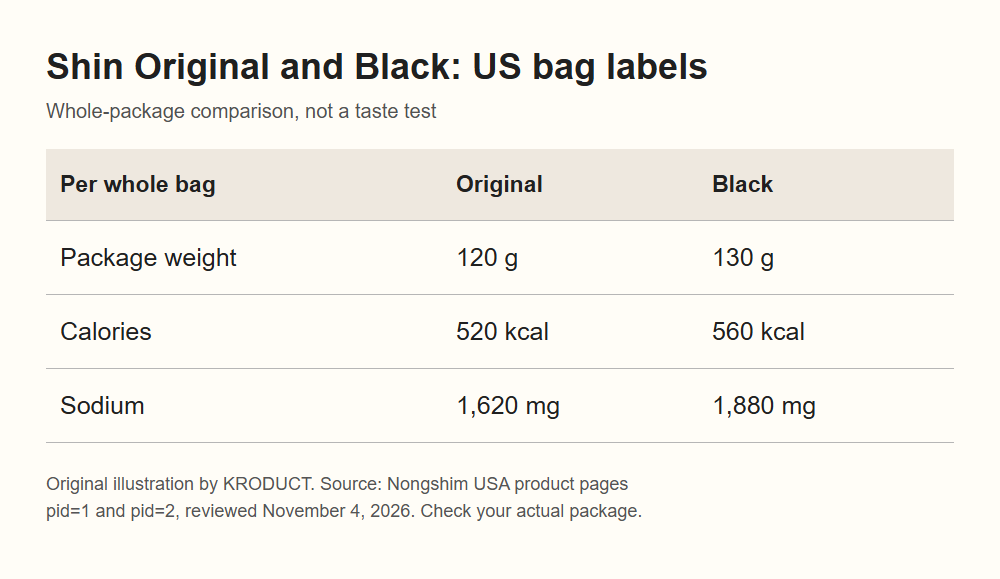
The illustration below summarizes just three of those facts side by side (total bag weight, full-bag calories, and full-bag sodium) as a quick visual reference; the full table above is the complete comparison.
Which Check Fits Your Shopping List?
Instead of a taste ranking, use these three label-based checks. Each is based only on what Nongshim prints on the Original and Black bag labels reviewed here, not on every Shin Ramyun variant the brand sells.
- Comparing calories or sodium for the full bag? Original’s official full-bag numbers (520 calories, 1,620mg sodium) are lower than Black’s (560 calories, 1,880mg sodium). Original also lists less total carbohydrate per bag (83g versus 89g).
- Curious about Nongshim’s description of Black’s beef bone broth? The clearest label clue is ingredient order: on Black’s label, beef bone extract is named as its own ingredient before the “contains less than 2%” group, while on Original’s label it sits inside that under-2% group. That tells you its position on the list, not its exact percentage or how it tastes. Nongshim’s own product page describes Black as featuring “a rich, velvety beef bone broth, infused with garlic and onions for deeper flavor.”
- Avoiding wheat or soy, or eating vegetarian? Neither of these two bags works. Both list “Contains wheat and soy,” and both ingredient lists include beef bone extract, beef extract, and beef fat. This applies to the Original and Black bags checked here; other Shin Ramyun products are not covered by this comparison.
Allergens: “Contains” Versus the Facility Note
Both bags carry two separate allergen statements that mean different things. The bold “Contains wheat and soy” line means wheat and soy are used as ingredients in that bag. Separately, Nongshim’s facility statement says the product is made in a facility that also processes milk, eggs, fish, crustacean shellfish, tree nuts, peanuts, and sesame. That statement only tells you those allergens are present somewhere in the same facility; Nongshim’s page does not say whether equipment or packaging lines are shared, so don’t read it as confirming that. For more on how US and Korean labels phrase this differently, see our guide to Korean food labels and allergens, and always check the actual package in front of you, since labels can change between printings.
Per 100g: For Comparing These Two US Bags Only
These per-100g figures apply only to the two US bags reviewed here, Shin Original and Shin Black; they are not a stand-in for a cup version, a different country’s packaging, or any other Shin Ramyun variant, each of which has its own weight and nutrition values. Using the official per-bag numbers: Original works out to about 433 calories and 1,350mg sodium per 100g, and Black works out to about 431 calories and 1,446mg sodium per 100g. That means Black’s sodium is about 96mg, or roughly 7.1%, higher than Original’s per 100g, even though the per-bag numbers above look further apart because the two bags are different total weights. If you want to run this same per-100g math on a cup version or another market’s bag, our Shin Ramyun calories and sodium by bag and cup label roundup lines up more formats you can check the same way.
A Hypothetical Price-Per-Weight Example
Neither official Nongshim page lists a price, so this is a hypothetical example only, meant to show the math, not a real quote for any store. Say a 5-pack of Original bags costs $6.25 and a 5-pack of Black bags costs $7.50 at a store on a given day, with no shipping fee added in this example. Original’s 5-pack totals 600g (5 x 120g), so $6.25 ÷ 600g x 100 = about $1.04 per 100g. Black’s 5-pack totals 650g (5 x 130g), so $7.50 ÷ 650g x 100 = about $1.15 per 100g. Comparing the $6.25 and $7.50 sticker prices alone makes it look like Black costs $1.25 more for “the same” 5-pack, but because Black’s bags are heavier, its real price gap per equal weight is smaller, about $0.11 more per 100g. That gap is exactly why a whole-pack price and a per-100g price can point to different conclusions, and why it is worth dividing the actual price on your receipt by the actual weight on the bag yourself, since real prices, pack sizes, and any shipping costs will differ by store and change over time.
A flat shipping fee changes that math again, and it’s worth testing with your own numbers before you check out. Say an online order under $35 adds a flat $4 shipping fee. Adding that to the Original order makes it $10.25 for the same 600g, or about $1.71 per 100g; adding it to the Black order makes it $11.50 for 650g, or about $1.77 per 100g. Spread across the same weight, a flat fee shrinks the gap between the two prices even further, which is why it’s worth redoing this division with your own cart total and your own order’s actual shipping fee, rather than assuming the no-shipping numbers above still apply.
Before you buy either bag, the one thing worth doing is flipping over the package in front of you and checking its total bag weight, its full-bag calories/sodium/protein in the Nutrition Facts panel, and its allergen statement, then dividing the total price you will pay by the total grams you are buying and multiplying by 100 to get your own price per 100g, which lets you match a single bag against a multipack on the same total-weight basis; if you are paying for shipping, include that shipping amount in the total price before you divide.
Sources
- Nongshim USA – Shin Ramyun Original product and Nutrition Facts page
- Nongshim USA – Shin Ramyun Black product and Nutrition Facts page
Last reviewed: November 4, 2026. Product recipes, prices, and availability change by country and by store; always check the package and the retailer before you buy.