US Shin Ramyun Original bag and Original Cup are separate product listings with different serving sizes and ingredient lists. The bag lists 260 calories and 810 mg sodium per half bag; the cup lists 300 calories and 1,200 mg per cup. Compare complete packages first, then the same dry weight.
Three ways to use this article, depending on what you want to know. Comparing one complete bag against one complete cup as purchased: start with the table below and read the percent Daily Value columns as printed. Wanting an apples-to-apples comparison that strips out package size: read the per-100-gram calculations further down. Managing a sodium or calorie restriction for medical reasons: treat everything here as background only, check the exact label on the box in hand, and confirm any plan with a clinician or registered dietitian, since packaging and formulas can change.
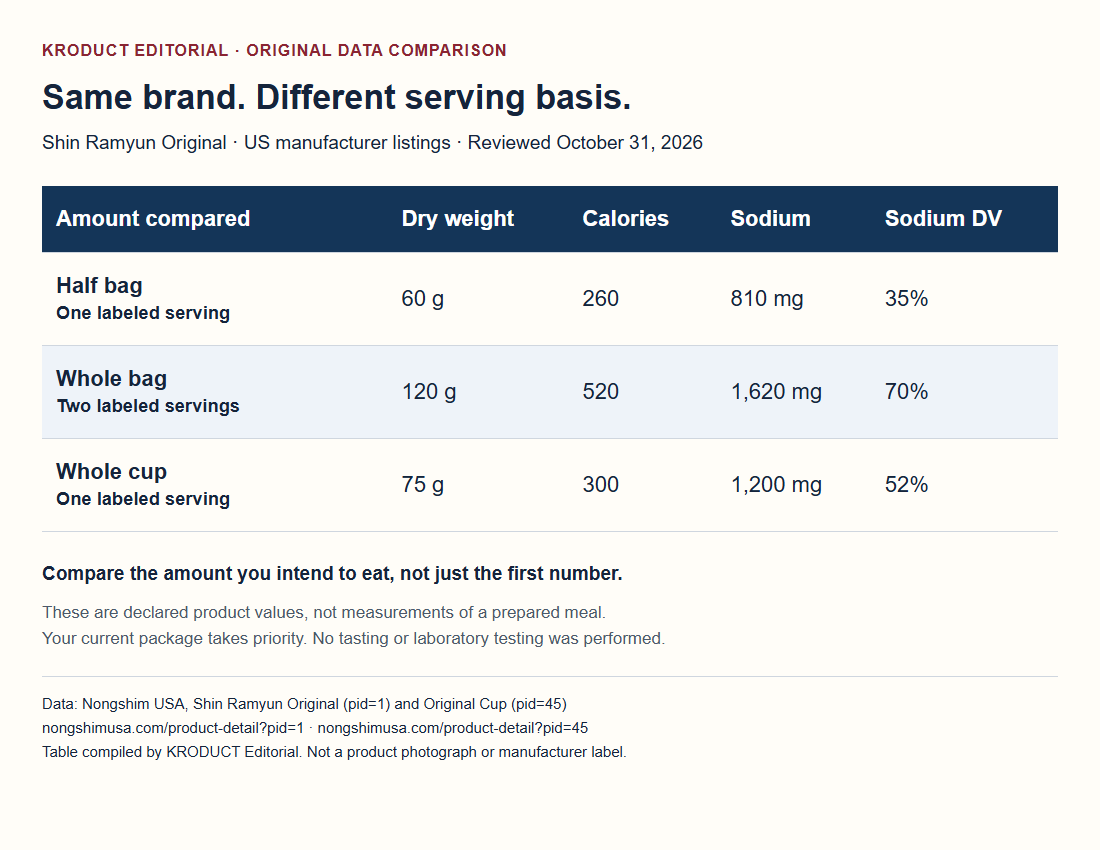
| Format | Serving basis | Calories | Sodium | Sodium % Daily Value |
|---|---|---|---|---|
| US Shin Ramyun Bag | Half bag, 60 g | 260 | 810 mg | 35% |
| US Shin Ramyun Bag | Whole bag, 120 g | 520 | 1,620 mg | 70% |
| US Shin Ramyun Cup | One cup, 75 g | 300 | 1,200 mg | 52% |
| US Shin Ramyun Bag | Calculated, per 100 g | ≈433 | ≈1,350 mg | n/a |
| US Shin Ramyun Cup | Calculated, per 100 g | 400 | 1,600 mg | n/a |
What the US Shin Ramyun Bag Label Actually Says
According to Nongshim USA’s official product page for US Shin Ramyun Original, the bag contains 2 servings per container, with each serving defined as one half bag at 60 grams. One half-bag serving lists 260 calories and 810 milligrams of sodium, marked at 35 percent of the Daily Value. The label’s per-bag column lists the whole 120-gram bag at 520 calories and 1,620 milligrams of sodium, or 70 percent Daily Value for sodium, as a directly declared figure rather than a simple doubled estimate. Per bag, the panel also lists 16 grams of fat, 8 grams of saturated fat at 40 percent Daily Value, 83 grams of carbohydrates at 30 percent Daily Value, 11 grams of protein, and 3 grams of fiber at 11 percent Daily Value. These are the manufacturer’s rounded figures, and rounding means whole-bag numbers are not always a perfectly clean double of the half-bag numbers.
The allergen statement lists wheat and soy as contained allergens, and separately discloses that the manufacturing facility also processes milk, eggs, fish, crustacean shellfish, tree nuts, peanuts, and sesame. The ingredient list includes beef. None of this is a ranking or a safety endorsement for any diet; it is simply what Nongshim USA states for this specific US product as of this review. Ingredient lists and nutrition panels change over time, so the physical package in hand is always the final authority over anything summarized in an article.
What the US Shin Ramyun Cup Label Actually Says
The US Shin Ramyun Cup is a separate listing on Nongshim USA’s site, built around a single 75-gram serving per container rather than a half-bag split. That one serving is labeled at 300 calories and 1,200 milligrams of sodium, or 52 percent Daily Value for sodium in the single cup as sold. The allergen statement for the cup lists wheat, soy, and sesame as contained allergens, with the shared facility also handling milk, eggs, tree nuts, peanuts, fish, and crustacean shellfish. The ingredient list also includes beef. This figure applies specifically to the US cup product referenced here; it is not the same as a Korean-market 65-gram cup, a bowl, a big bowl, or any other regional variant, each with its own serving size and panel. Swapping numbers between formats without checking the actual label is where confusion starts.
Comparing Complete Packages As Sold
Looking at each format exactly as sold, without conversion, gives a first useful comparison. A full 120-gram bag is 520 calories and 1,620 milligrams of sodium at 70 percent Daily Value. A single 75-gram cup is 300 calories and 1,200 milligrams of sodium at 52 percent Daily Value. A complete bag contains 220 more declared calories and 420 mg more sodium than a complete cup. These totals compare different package weights; they do not show what causes the differences, since the two products are separate formulations with their own ingredient lists, not larger and smaller versions of the same recipe.
Normalizing to the Same Weight
Scaling both products to the same dry weight permits a per-weight comparison of their declared nutrients. It does not establish which ingredients or manufacturing steps caused the differences. Using the manufacturer’s own rounded declared values and simple proportional math, the bag’s 520 calories and 1,620 milligrams of sodium per 120 grams works out to roughly 433 calories and 1,350 milligrams of sodium per 100 grams. The cup’s 300 calories and 1,200 milligrams of sodium per 75 grams calculates to 400 calories and 1,600 milligrams of sodium per 100 grams from the rounded label values. On this normalized basis the relationship flips: the cup carries about 250 milligrams more sodium per 100 grams than the bag, even though the whole bag has more sodium per package. The package-level comparison and the per-weight comparison measure different things and can point in opposite directions at once.
These per-100-gram figures are calculations from the manufacturer’s rounded declared values, not independent laboratory measurements. They do not account for how the soup is prepared, how much broth is actually consumed, or any adjustments made to powder or liquid. They are not a single combined health rating; they are a weight-normalized restatement of the same declared numbers for comparison purposes.
Why Serving Size Matters on Any Nutrition Label
The FDA’s guidance on how to understand and use the Nutrition Facts label explains that serving size reflects the amount people typically eat or drink of that food, not a recommendation about how much to consume. All nutrient amounts on a panel, including calories, are based on that stated serving size, which is why two products with different serving sizes can show very different absolute numbers even with a similar underlying recipe. The FDA explains that certain products require dual-column labels showing nutrients per serving and per package or unit, helping readers identify the amounts in the entire package.
On Percent Daily Value, FDA guidance treats 5 percent Daily Value or less as low and 20 percent or more as high, with the agency’s 2,300 milligram sodium Daily Value and 2,000 calorie reference serving as broad educational benchmarks, not personalized prescriptions. That distinction matters here: a half-bag serving at 35 percent Daily Value for sodium already sits in the agency’s high range before anyone eats more than half the package, and a whole bag or a cup push further into that territory depending on how the serving is defined.
What These Labels Do Not Tell You
The half-bag serving definition is a labeling convention, not proof that the noodles and powder inside an actual bag are physically split into two exactly equal halves; eyeballing half a bag of noodles and half a packet of powder is an approximation, not a lab-verified 50-50 split. These figures also cannot tell anyone how much sodium they actually eat if they discard some broth, use less seasoning powder than the package suggests, or add extra water. Adding water changes the concentration of the soup as served, but not the total calories or sodium contributed by the noodles and seasoning if everything from the package is eventually consumed. None of the sources used here quantify how cooking adjustments change real-world intake, so this piece does not estimate or recommend any particular amount of broth, powder, or water to use.
Where to Go From Here
If preparation steps are the next question, a separate walkthrough on how to cook Korean ramen covers stovetop method rather than nutrition figures. For a closer look at allergen wording and shared-facility cross-contact disclosures across Korean ramen brands, see the guide to Korean food labels and allergens. For general retailer and seller-verification checks, see where to buy Korean ramen, keeping in mind that stock and pricing for these specific bag and cup formats are not addressed in this article.
Editorial Scope
This article compares officially published US label data for two Nongshim USA product listings, the Shin Ramyun bag and the Shin Ramyun cup, read directly from the manufacturer’s own product pages, alongside general FDA guidance on Nutrition Facts labels. It involves no hands-on tasting, cooking test, or sensory evaluation, and makes no claims about taste, texture, or quality. It is not a substitute for the nutrition and allergen panel on the specific package in hand, and it is not medical or dietary advice; anyone managing a health condition should consult the current label and a qualified clinician or dietitian before deciding based on these figures. Ingredient formulations, serving definitions, and nutrition values are subject to change by the manufacturer, and only the physical package at time of purchase is authoritative.
Last reviewed: October 31, 2026