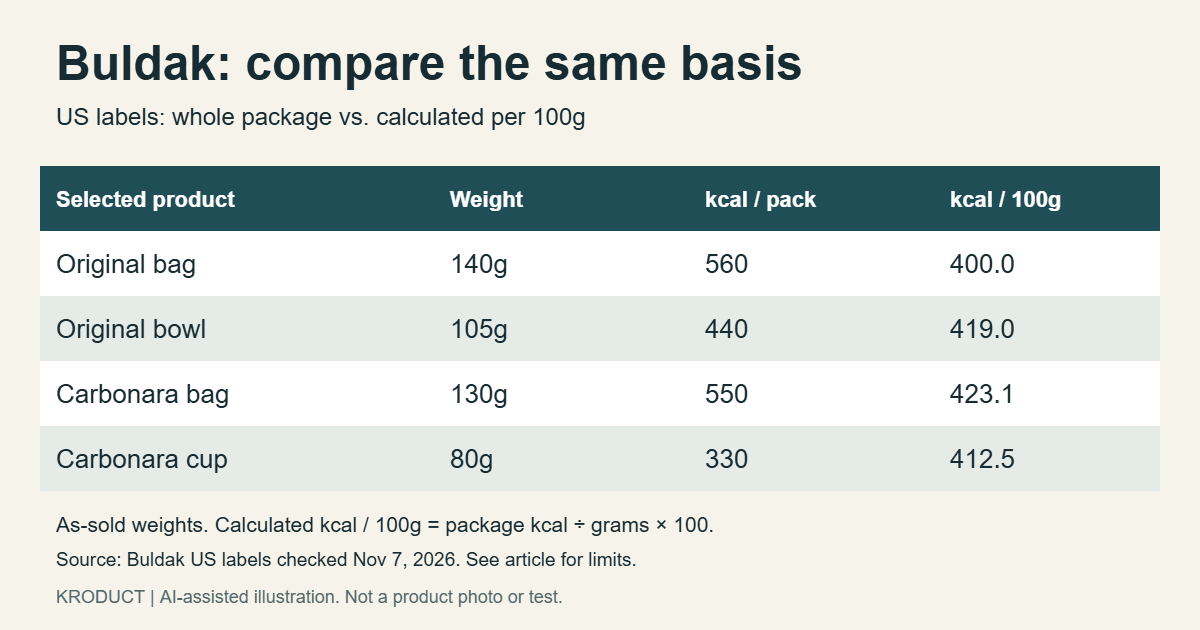
A smaller Buldak package can have fewer calories in total and still contain more calories per 100 grams. In the US labels checked here, Original’s 105g bowl lists 440 calories versus 560 for the 140g bag. Divide each by its package weight, however, and the bowl comes out at about 419 calories per 100g, above the bag’s 400.
Carbonara produces a different reversal: its 80g cup has less sodium per package than its 130g bag, but more sodium per 100g. These are two different shopping questions, not contradictory labels. The useful choice is which denominator matches what you want to compare.
Last checked: November 7, 2026. This is a comparison of four manufacturer-published US labels, with our own calculations. It is not a tasting, cooking test or physical-package inspection.
- Comparing one complete package: use the package totals; exclude outer multipacks from that count.
- Comparing equal product weights: use the calculated 100g figures; exclude cooked noodle weights and added water.
- Matching a shelf listing: match flavor, format and grams before using any number; exclude other markets and unverified sizes.
The reversal depends on what “less” means
For Original, switching from the checked bag to the checked bowl means 35g less product, 120 fewer labeled calories and 670mg less labeled sodium per complete package. That does not mean the bowl has a lower concentration of both nutrients. Its calorie density is approximately 4.8% higher, while its sodium density is lower.
For Carbonara, the checked cup contains 50g less product than the bag. Its complete-package totals are 220 calories and 450mg sodium lower. Yet its sodium density is approximately 7.5% higher. Its calorie density, unlike Original’s smaller format, is slightly lower than the bag’s.
Neither comparison identifies a universally better product. Package totals describe the labeled amount in one unit; density lets unequal sizes share a denominator. Neither establishes flavor preference, fullness or personal dietary suitability. Calories also do not measure heat: use the separate Buldak spice-level guide for that different comparison.
First, identify the exact four labels
Each selected Nutrition Facts panel states one serving per container, so the displayed per-serving amounts also equal one entire retail package. The sodium percentages below are the percentages printed on those labels, not percentages recalculated from our rounded table.
| US product | Labeled serving | Servings per container | Calories per package | Sodium per package | Printed sodium %DV |
|---|---|---|---|---|---|
| Original bag | 1 bag (140g) | 1 | 560 | 1,630mg | 71% |
| Original bowl | 1 bowl (105g) | 1 | 440 | 960mg | 42% |
| Carbonara bag | 1 bag (130g) | 1 | 550 | 1,330mg | 58% |
| Carbonara cup | 1 cup (80g) | 1 | 330 | 880mg | 38% |
The source pages are Buldak’s US Original bag, Original Big Bowl listing, Carbonara bag and Carbonara cup. These links identify the selected products rather than establish store availability.
Original has a naming mismatch: the official catalog and URL identify Big Bowl, but the product-page heading reads “Buldak Ramen Original Cup 3.70 OZ (105g).” Its nutrition image explicitly says “1 bowl (105g).” We call this entry the 105g bowl to track that nutrition panel, not a separate Original Cup product.
The Carbonara cup here is 80g, not a 105g bowl. We did not verify a US Carbonara 105g big-bowl label in this investigation. That is a limit of this selection, not proof that such a product cannot exist. Cream Carbonara is also outside this four-product comparison; the Carbonara versus Cream Carbonara pouch guide addresses that separate product distinction.
Put the same 100 grams under both numbers
Our formula is: labeled package amount ÷ labeled package grams × 100. Apply it separately to calories and sodium. For the Original bowl, 440 ÷ 105 × 100 gives approximately 419.0 calories per 100g. For its bag, 560 ÷ 140 × 100 gives 400.0.
For Carbonara sodium, the cup calculation is 880 ÷ 80 × 100 = 1,100mg per 100g. The bag calculation is 1,330 ÷ 130 × 100, approximately 1,023mg. A lower package total and a higher equal-weight figure can therefore both be correct.
| US product | Our calorie calculation | Calories per 100g | Our sodium calculation | Sodium per 100g |
|---|---|---|---|---|
| Original bag | 560 ÷ 140 × 100 | 400.0 | 1,630 ÷ 140 × 100 | 1,164mg |
| Original bowl | 440 ÷ 105 × 100 | 419.0 | 960 ÷ 105 × 100 | 914mg |
| Carbonara bag | 550 ÷ 130 × 100 | 423.1 | 1,330 ÷ 130 × 100 | 1,023mg |
| Carbonara cup | 330 ÷ 80 × 100 | 412.5 | 880 ÷ 80 × 100 | 1,100mg |
These are our normalized figures, not additional manufacturer label claims. Calories are displayed to one decimal and sodium to the nearest milligram for comparison. The underlying labels are rounded, so the extra arithmetic does not create laboratory precision. The percentage differences above were calculated before display rounding.
Do not let preparation change the denominator unnoticed
The 100g basis here is labeled as-sold product weight, not 100g of finished noodles. Added water changes prepared weight, and draining changes how much water remains. We did not measure cooking yields, so these figures cannot be used as nutrition values for a weighed 100g serving of cooked Buldak.
Follow the instructions on the exact package rather than transferring a bag method to a cup. Our Korean ramen cooking guide provides preparation context, but it does not supply a verified cooked-weight conversion for these four labels.
The panels also do not separate noodle, sauce and powder nutrition. Using less sauce does not give enough information to calculate a precise calorie or sodium reduction. The guide to making Buldak less spicy covers a different preparation goal; do not turn a sauce adjustment into an unsupported nutrition estimate.
Choose a reference before choosing a format
The next table is a shopping workflow, not a second ranking of the same numbers. Start with your actual question, choose the relevant reference, then check whether the package in front of you belongs in this comparison.
| Shopping question | Reference to use | Action before buying | What it cannot decide |
|---|---|---|---|
| What is in one complete unit? | Package calories, sodium and serving count | Read the individual unit, not only the outer multipack | Equal-weight nutrient density |
| Are unequal sizes comparable? | Our as-sold 100g calculations | Confirm the listed gram weight matches your package | Nutrition per 100g cooked noodles |
| Does an online listing match? | US flavor, format, weight and panel | Request a readable current label if the listing is ambiguous | Stock, delivery cost or recipe consistency |
| Does it fit an allergy restriction? | Current ingredients and allergen statements | Check the actual package and clarify unresolved information | Cross-contact absence or personal suitability |
For seller and package checks, continue to where to buy Korean ramen. We did not compare current prices, shipping charges or stock, so no value-for-money winner follows from this article.
Allergy screening remains separate from calorie arithmetic. The US Buldak milk-label comparison addresses that specific concern. For a package intended for another market, use the Korean food label and allergen guide rather than borrowing these US numbers. Neither calorie rank nor flavor name confirms allergy, vegetarian or certification suitability.
Use sodium %DV as context, not a personal prescription
The FDA sodium guide uses 2,300mg as the general Daily Value reference and describes 20% DV or more per serving as high. All four selected labels exceed that high-sodium guide, including the smallest cup. A lower total within this selection does not mean “low sodium.”
The FDA label-reading guide also explains that serving size is not a recommendation for how much to eat. The 2,300mg reference is not an individualized limit for every reader. These comparisons do not prescribe a personal intake or establish that one format is healthier overall.
What we investigated, and what remains unknown
On November 7, 2026, we selected Original and Carbonara through Buldak’s US catalog filters, opened the four product pages and read their Nutrition Facts and ingredient information. We used those four US labels and the two FDA resources above. Our independent contribution is one label-selection and normalization investigation: matching formats and gram weights, calculating equal-weight values, and identifying the two ranking reversals.
No physical package, lot, cooked yield or component nutrition was independently tested. Manufacturer web labels may differ from a later package or another market. This article reproduces no product photographs or label images; its three tables are our own comparisons. For the same denominator method applied separately to another ramen, see the Shin Ramyun bag-and-cup label comparison.
Before checkout, check the US market designation, flavor, net grams and serving line on your package. Use its whole-package figures for that unit and an equal-weight calculation only when that is the question you mean to ask.